
 by John Parkins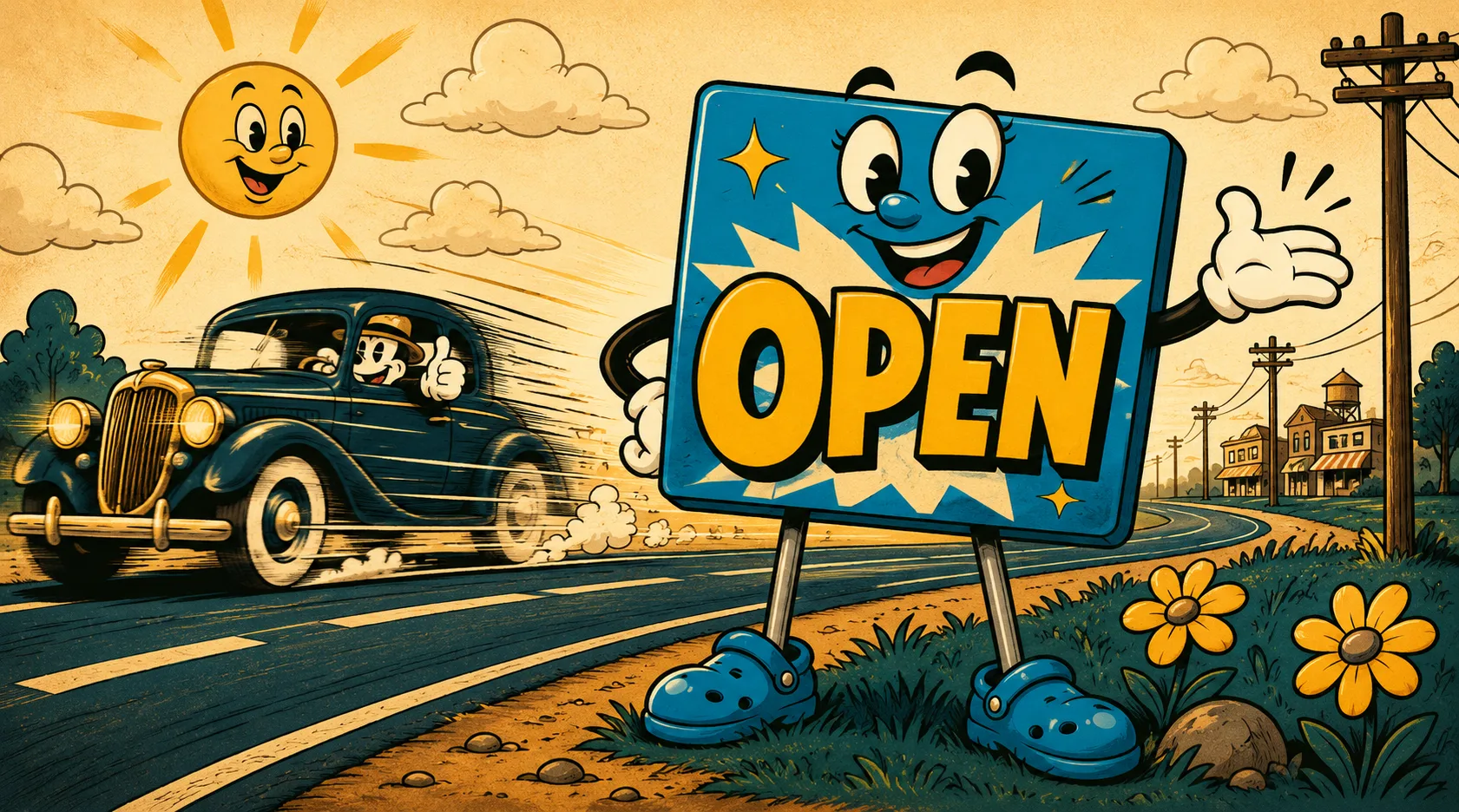
You see them every weekend. Stapled to telephone poles, jammed into the strip of grass between the sidewalk and the curb, propped against a stop sign. Lawn care. Roof inspection. We buy houses cash. Vote for somebody. A garage sale that was already two weeks ago.
Most of them are unreadable. Some of them are illegal. A lot of them are both.
A yard sign is a billboard with a budget problem. You've got two seconds, maybe three, to land a message in the brain of someone driving past at 35 miles per hour. That's it. Two seconds. The math doesn't care how nice your logo is or how clever your tagline reads on your laptop. If a driver can't catch the message at speed, the sign isn't marketing. It's litter with a stake on it.
Here's what actually works.
The two-second test
A car moving at 35 mph covers about 51 feet every second. At 45 mph, it's closer to 66 feet a second. So if you want a driver to read your sign as they pass it, you've got two seconds of useful time. Three if you're lucky and they're not looking at their phone.
In those two seconds, the brain can absorb roughly five to seven words. Not five to seven words per line. Five to seven words total. That's your whole message. The name of the business, what the business does, and a phone number. Anything more is for the people who pull over, and people don't pull over for yard signs.
Before you finalize a design, do this: print it at full size, tape it to a fence in your front yard, and drive past it at 30 miles an hour. If you can't read it on the first pass, your customers can't either. Doesn't matter how good it looks on a screen.
Letter height: the only rule that matters
Every sign shop and every signage association agrees on this one. One inch of letter height equals ten feet of comfortable reading distance.
So a 3-inch tall letter reads cleanly from about 30 feet. A 5-inch letter reads from 50 feet. A 10-inch letter reads from 100 feet.
For a standard 24x18 yard sign on a 35 mph road, your main message needs to be at least 3 inches tall. Bigger is better. Your phone number can be smaller, but not by much. If your phone number is half an inch tall and someone is driving past at street speed, they would have better luck reading the VIN number on a passing semi.
A note on font size in design software. The "72 pt" you see in Illustrator or Canva is not the same as 1 inch of letter height. Different fonts at the same point size print at very different visible heights. Always measure the actual cap height, not the point size. If you don't know how to do that, you probably shouldn't be designing the sign.
Fonts: pick the boring one
Bold sans-serif fonts win. Impact, Bebas Neue, Helvetica Bold, Roboto Black, Inter Black. Boring is the goal. Boring reads from a moving car.
Script fonts, thin fonts, decorative fonts, anything with serifs thinner than a pencil line. These are for wedding invitations and your grandmother's cross-stitch. They are not for yard signs. The eye can't process the curls and flourishes at 35 mph, so the brain just files the whole sign under "I don't know, something" and moves on.
If you're tempted to use Comic Sans, the answer is no. I'm not going to explain it. Just no.
Color: contrast or quit
The biggest design sin in yard signs is low contrast. A medium blue logo on a slightly lighter blue background looks fine on your monitor. From across the street it looks like a blur. Pull the saturation, change the lighting, add some sun glare, and now it looks like nothing at all.
The combinations that read best from a distance:
- Black text on white background (boring, undefeated)
- White text on dark blue or black background
- Black text on yellow background (the school bus combo, and there's a reason it works)
- White text on red background
Pretty colors are for the inside of the sign shop. Outside, you need the message to punch through bad weather, low sun, and the half-second the driver actually looks at it.
Material: 4mm coroplast and step stakes
For 95% of small business yard signs, the right answer is 4mm corrugated plastic in a 24x18 horizontal format, mounted on step stakes (the H-shaped wire frames you push into the ground). It's lightweight, weatherproof, cheap enough to print 25 or 50 at a time, and tough enough to last a season or two.
If you want longer life, you can step up to aluminum or PVC. Aluminum looks more permanent. PVC is somewhere in between. Both cost more and take longer to install because you can't just stab the ground with them.
What you don't want: paper signs in a plastic sleeve, cardboard signs of any kind, and the absolute cheapest signs from the discount online printers. They warp, they fade, and the colors shift after one hard rain. A coroplast sign that costs three dollars more is going to last ten times as long and look ten times better doing it.
Where you can actually put them (the legal part)
Here's where most people get themselves in trouble, including a lot of people who absolutely should know better.
You cannot put a yard sign in the public right-of-way. This is the strip of grass between the sidewalk and the curb, the area around telephone poles, the median, the ditch alongside a state highway, or anywhere on city or county or state-owned land. Doesn't matter that there's grass there. Doesn't matter that nobody seems to be using it. It's not yours.
In Ohio, the state Department of Transportation will pull any sign found in the right-of-way along a state route. They haul it to the nearest county garage and hold it for 30 days. After that, it goes in the trash. So all those "We Buy Houses" signs taped to the stop sign at the corner of a state highway? Gone by Tuesday.
For Lima specifically, here's the short version: signs under 2.5 square feet don't require a permit. Anything bigger does. And in any case, signs need to be on private property with the owner's permission, not in the public right-of-way. The City Planning Department is the place to call when you're not sure (419-228-1836). They will tell you. They would rather you ask than have to send someone to pull your signs.
If you're not sure where the right-of-way starts and ends in your area, a good rule of thumb is anything within about 16 feet of the pavement edge on a road without a sidewalk. If you've got a sidewalk, the right-of-way is everything between the sidewalk and the street, plus a few feet on either side. When in doubt, set the sign back further than you think you need to.
The smart play: ask a homeowner or business owner if you can put a sign in their yard, set it well behind any sidewalk or curb, and move on. People say yes more often than you'd think, especially if you've actually done good work for them.
What to put on the sign
Three things, in this order, top to bottom:
- What you do (the biggest text). "Roof Repair." "Tree Removal." "Yard Sale." "Open House." Not your business name. The thing you do that solves a problem.
- Your business name (medium text). Not the lead. Most people don't care about the name until they care about the service.
- How to reach you (clear, readable text). One phone number. Or a URL if it's short and memorable. Pick one. Don't put both, and definitely don't put both plus a QR code plus an email address. The driver is going to remember exactly one piece of contact info. Make it the one you actually want them to use.
That's the whole sign. No tagline. No mission statement. No five-star rating badge. No "family owned since 1987." Save that stuff for your website, your direct mail, or anywhere a person is actually standing still long enough to read it.
A word on QR codes
QR codes on yard signs facing a busy road are a waste of ink. Nobody is going to slow their car down, pull over, get their phone out, and scan a code on the side of the road. The QR code is a thing you put on signs that get viewed up close. Open house signs you walk up to. Job site signs you stop in front of. A-frame signs on a sidewalk. For a sign that's meant to be seen from a moving car, the QR code is dead weight.
The bottom line
A yard sign is supposed to do one job: get someone who's driving past to remember a name and a number for the thirty seconds it takes them to get home. That's it. That's the whole job.
If your sign tries to do more than that, it does less than that. Big bold text, a clean color combination, the right material, a legal spot to put it, and three pieces of information. That's a yard sign that works.
Everything else is just litter with better aspirations.